

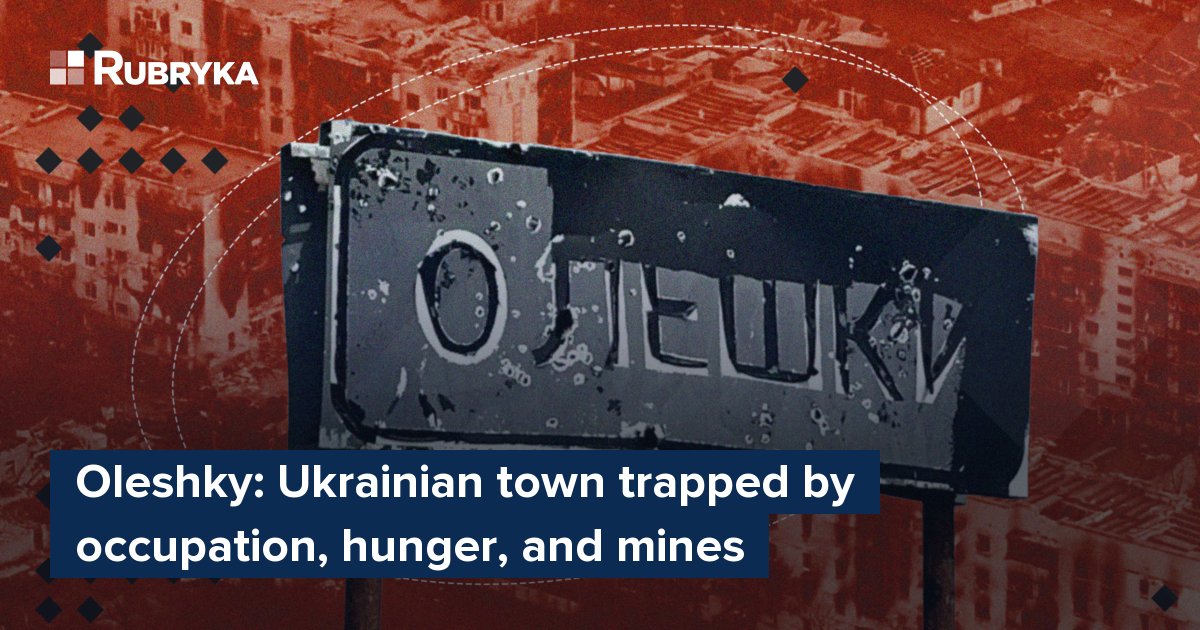
Oleshky, a Russia-occupied town in Ukraine's southern Kherson region, is facing a humanitarian catastrophe. No food or medicine is reaching the town; basic utilities have collapsed, and medical care is out of reach for the remaining residents, many of whom are from vulnerable social groups.
For civilians, there is no safe way out. Roads around Oleshky are mined, and those who try to flee face Russian drone and artillery attacks. Russia is also blocking humanitarian aid and impeding efforts to establish a humanitarian evacuation route.
Rubryka explains the crisis in Oleshky, how Russia is trapping civilians, and why the situation demands international attention.
Oleshky: a town that went through it all
Before the full-scale war, Oleshky, one of the Kherson region's oldest towns, was a popular tourist destination. It was a gateway from Kherson to the left bank of the Dnipro River and everything it had to offer — Oleshky Sands surrounded by pine forests, vast steppes and nature reserves, lakes and rivers, local wineries, and, farther south, the Black Sea.
Oleshky and its surrounding community, home to about 40,000 people, were occupied by Russian forces in the early days of the full-scale invasion in 2022. The area has remained occupied ever since, marked by the familiar abuses of Russian occupation: residents have reported arrests, persecution, and torture.

Oleshky is a town across the Dnipro River from Kherson, the regional capital. Screenshot from Google Maps
When Ukrainian forces liberated Kherson and the right bank in November 2022, many Oleshky residents hoped their town would be next. But as Russian forces withdrew, they destroyed the only link between Oleshky and Kherson across the Dnipro — the Antonivka Road Bridge. With the bridge gone, hopes of a quick liberation began to fade.

The flooded town of Oleshky after the destruction of the Kakhovka dam. Photo credit: AP
In June 2023, Oleshky faced another disaster caused by the Russian occupation. Russian forces blew up the Kakhovka dam, triggering widespread flooding, and the Oleshky community was among the first areas hit. According to Tetiana Hasanenko, head of the exiled Oleshky City Military Administration, more than half of the community's settlements were flooded, with water rising to over 6 meters.
The exact number of civilians killed by the flooding could not be verified because the area was inaccessible. Hasanenko, however, said the death toll was estimated in the hundreds. In the aftermath of the dam's destruction, residents and volunteers risked their lives to organize emergency aid and evacuations in Oleshky. Many people managed to escape.
Oleshky now: no food, medicine, or basic services
With much of the evacuation organized by volunteers and the humanitarian situation continuing to deteriorate, Oleshky's population has fallen sharply since 2023. An estimated 2,000 people remain in the city itself, while more than 6,000 civilians may still be living across the wider Oleshky territorial community, including about 200 children.

A bird's-eye view of Oleshky. Screenshot from a video by the 34th Borysfen Separate Marine Brigade
The exact number of civilians in need is unknown because communication with the occupied parts of the Kherson region is extremely difficult. Ukrainian local authorities now work from exile, outside the occupied territory, and rely on evacuated residents, volunteers, and the military for information about conditions on the ground.
Hasanenko said that, based on reports, Oleshky had been without centralized electricity, gas, heating, or water supplies. Residents have been forced to cook over open fires. Food and medicine deliveries became especially difficult during the winter of 2025 and 2026, when Russian forces tightened their blockade of the town.
Ukraine's Human Rights Commissioner Dmytro Lubinets confirmed the severity of the situation: "People are forced to ration every sip of water and every crumb of food. Attempts to deliver food have resulted in drivers being killed or deliveries being abandoned because of the deadly danger on the roads. This is not simply a humanitarian crisis. It is a deliberate campaign of terror by the Russian Federation against civilians."

A Russian drone attacked a column of four vehicles that tried to deliver food to Oleshky. Screenshot from the video published by volunteer Kseniia Arkhipova
By spring, the situation had deteriorated further. Kseniia Arkhipova, a volunteer who has helped residents of occupied towns evacuate to Ukrainian-controlled territory, told Suspilne that Russian occupation authorities were doing nothing to provide Oleshky residents with necessities: "There is no food for people, no food for animals, no cereals, no flour, no medical assistance because there are no medicines."
Videos shared by Oleshky residents show signs reading "No food, we're starving too," and people preserving and scavenging for whatever food they can find. Russian soldiers have also reportedly blocked vehicles carrying food from entering the city and turned residents away at checkpoints. According to locals cited by Bild, soldiers allegedly told people seeking assistance to "go back and die there."
The last supply truck reached Oleshky on May 26, 2026. The UN Human Rights Monitoring Mission confirmed that no further food deliveries had reached the city since then.
No way out for Oleshky civilians
Roads around Oleshky are mined and exposed to drone attacks, while shelling has made access even more dangerous. In an interview with 24TV, American journalist and filmmaker Zarina Zabrisky, director of the documentary Kherson Human Safari, said the Ukrainian military describes the situation as a "drone blockade." According to Zabrisky, Russian forces have used drones to remotely mine roads connecting several settlements along the occupied riverbank.
The UN Human Rights Monitoring Mission (HRMMU) also documented frequent drone attacks and landmines in occupied frontline communities in the Kherson region, including Oleshky and Hola Prystan. The report stated that the mines have obstructed both evacuation and access to necessities.
"Frequent attacks by short-range drones and the presence of landmines are having devastating consequences for thousands of people in these communities," said Danielle Bell, Head of HRMMU. "People can't get out, food can't get in, and sick and injured are not getting the medical assistance they need."

A bird's-eye view of a burned car after a drone attack on the road between Oleshky and Skadovsk. The main highway from Oleshky is called by locals "the road of death." Photo credit: 34th Borysfen Separate Marine Brigade
As with food deliveries, the last evacuation from the community took place in the spring. Since then, reaching Oleshky has become increasingly dangerous and nearly impossible. Volunteers reportedly tried to reach the town in July and August, but both attempts came under heavy shelling, forcing the vehicles to turn back.
With no safe evacuation route available, some residents have begun trying to escape on their own. On September 16, Lubinets said people were crossing mined fields because they saw no other way out of "this hell."
"They risk being blown up by a mine or hit by a drone, but they keep going anyway because staying in Oleshky is even worse for them," Lubinets said.
What Ukraine is doing to evacuate Oleshky residents
Since May, Ukraine has been trying to set up a humanitarian evacuation route from Oleshky and nearby occupied settlements. Later in the same month, Ukraine and Russia reportedly agreed on the technical details for evacuating about 6,000 civilians from the wider Oleshky area, including around 200 children.
As part of the agreement, Lubinets, Ukraine's ombudsman, asked the International Committee of the Red Cross (ICRC) to help secure the ceasefire needed for the humanitarian mission. In July, Ukrainian and Russian authorities began preparing lists of residents who had registered to leave. Despite preparations, the evacuation has yet to take place. The reason why it hasn't happened is Russia.

Ukraine's Human Rights Ombudsman Dmytro Lubinets. Photo credit: Ukrinform
On September 16, Lubinets said that Russia had still not confirmed its willingness or readiness to proceed with the evacuation plan. He said the two sides had agreed on a list of evacuees, worked out the mission's procedure, and secured support from the ICRC and Ukraine's Security and Defense Forces.
International pressure: not staying silent about Oleshky
Meanwhile, Ukraine has been raising awareness of the situation with the international community. Since May, the Ministry of Foreign Affairs has drawn attention to the humanitarian crisis in the occupied parts of the Kherson region and said it plans to raise the issue with the United Nations and the Organization for Security and Cooperation in Europe.
"For Ukraine, nothing is more valuable than human life. We urge the international community to take immediate, concrete action to save our citizens in the occupied Kherson region," the ministry said in a statement.
Lubinets said he had also warned international organizations, including the UN and the International Committee of the Red Cross headquarters in Geneva, about the critical situation in Oleshky.

Ukrainian Foreign Minister Andrii Sybiha. Photo credit: Ukrinform
On September 15, Ukrainian Foreign Minister Andrii Sybiha called for international access to Oleshky and help evacuating residents who lack food, medicine, and a safe way out.
"This situation is a stark reminder of what life under Russian occupation really means — and of what is at stake when people speak casually about leaving Ukrainian territories under Russian control. These are not just lines on a map or bargaining chips at a negotiating table. Real people live there, and their daily lives are controlled by an occupying power that has already shown how it treats Ukrainians under its rule," Sybiha said.
The Holodomor Museum, which preserves the memory of the Holodomor — the famine and genocide of Ukrainians carried out by the Soviet regime — has also called on international organizations not to look away from the crisis in Oleshky and to pressure Russia to act.
"We are convinced that silence around a mass humanitarian crisis is unacceptable, and we call on the international community not to ignore the situation in Oleshky," it said.
For now, residents remain trapped between worsening conditions inside the town and the danger of trying to escape through areas threatened by mines and drone attacks. Ukrainian authorities continue preparations and talks with Russia.
"We continue to call on the Russian side to urgently evacuate people who are effectively trapped in the gray zone," Lubinets stated. "Every day, these civilians face the threat of shelling and drone attacks, while going without food, drinking water, medicine, and other essentials. They need to be rescued. Oleshky has become a death trap."